Context
Forensic Face explored how facial-recognition methods could assist difficult forensic identification where available visual evidence was incomplete, degraded or limited to human remains. It sits within Benjamin’s NEC-era body of secure-identity and biometric work.
The work belongs in the case-study library because it shows the breadth of identity problems Benjamin was considering: not only live access control, but also complex investigative contexts where visual evidence may be incomplete, degraded or connected to human remains.
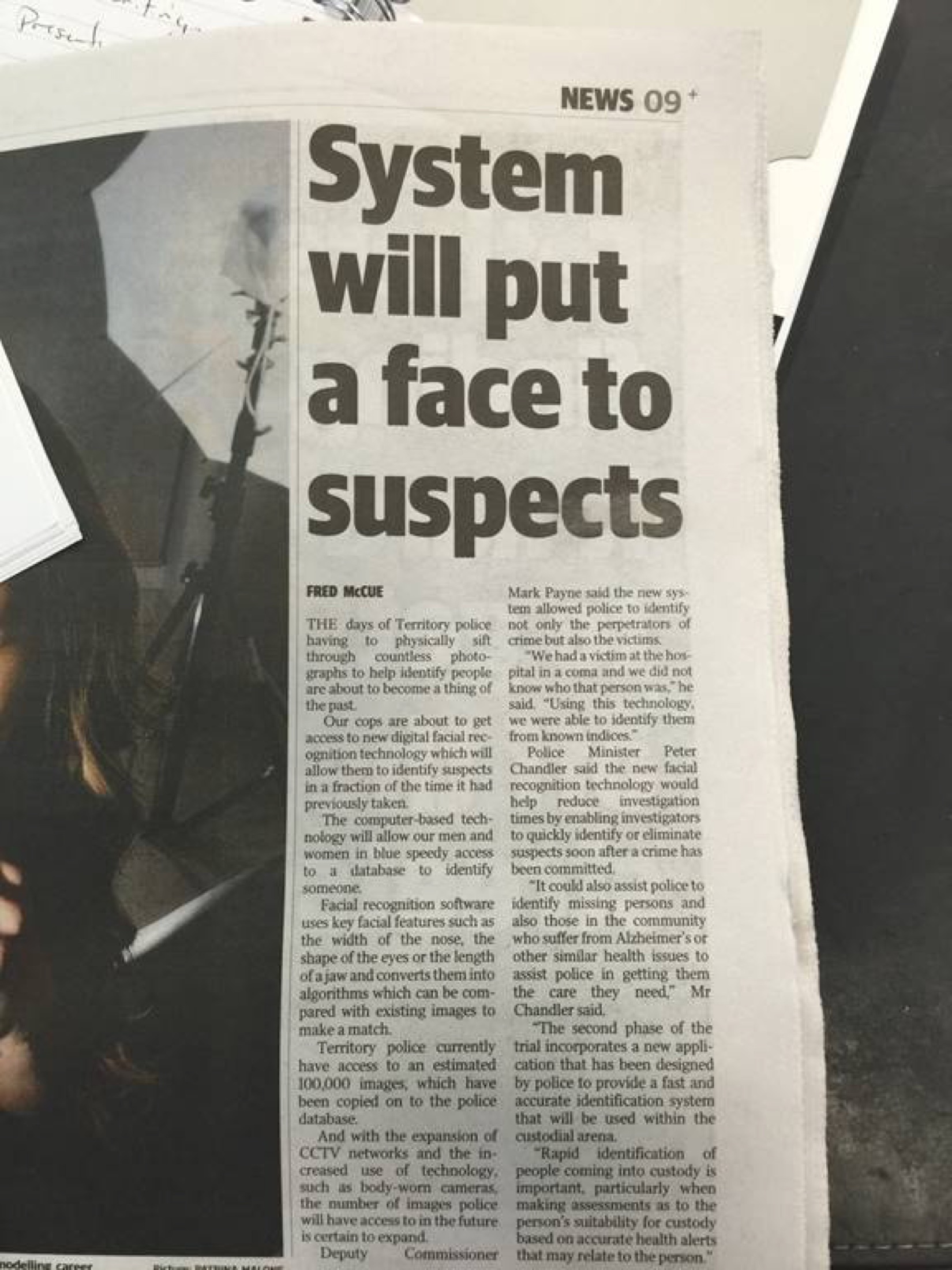
The broader NEC and NT Police facial-recognition partnership used NEC NeoFace Reveal, a latent face workstation for enhancing poor-quality face images, searching mugshot repositories and presenting ranked candidate lists for expert review. Forensic Face extended the same identity discipline into more difficult visual-evidence problems.
Problem
Forensic identification can involve difficult visual evidence where traditional comparison methods may be slow, specialist or uncertain. Faces may be decomposed, skeletal evidence may be all that remains, and families may be waiting for answers. Any technology concept in this area must be treated carefully because identification errors can have serious legal, ethical and human consequences.
The challenge was to define how facial-recognition approaches could support forensic workflows without overstating accuracy, bypassing expert judgement or weakening evidentiary governance.
Benjamin’s Role
Benjamin led solution development and management for an identity concept in justice-adjacent operating environments, connecting technical possibility with evidentiary discipline, human review and governance expectations.
What Benjamin Built Or Changed
The work explored how facial-recognition algorithms can assist forensic identification scenarios involving decomposed faces, skulls and difficult visual comparison problems. Benjamin framed a hard identity problem with discipline: technology had to support expert judgement, not replace it.
The technology was successfully used to support a number of high-profile cold and active cases. It also helped repatriate unknown victims of Cyclone Tracy with their families and was featured by 60 Minutes Australia.
The public facial-recognition material around the NT Police partnership showed the practical operating base for this kind of work: large image repositories, poor-quality latent images, CCTV and mobile evidence, and the need to identify suspects, missing persons and people who may pose a risk to themselves or the public. Forensic Face applied that identity capability to more complex investigative and humanitarian contexts.
Stakeholders
Law-enforcement, forensic, justice, technology, governance, privacy, victim-identification and family stakeholders.
Delivery Approach
The approach treated forensic identity as a high-consequence decision-support problem. Expert validation, evidentiary governance, human review, privacy assessment, accuracy and false-match risk were design considerations from the beginning.
Benjamin’s contribution was to connect advanced identity technology thinking with the real constraints of justice-adjacent use cases.
Outcomes
The work strengthened Benjamin’s broader NEC-era biometric identity body of work. It reinforced the importance of treating identity technology as a governed decision-support tool rather than a substitute for expert judgement, while demonstrating that facial-recognition capability could support real investigative and humanitarian outcomes when applied carefully.
Its strongest value was the combination of technical ambition and judgement. The point was not facial recognition for its own sake; it was the ability to give investigators and families another disciplined pathway when ordinary identification evidence was degraded, incomplete or connected to human remains.
What It Demonstrates
Advanced identity problem framing, forensic-use-case awareness, humanitarian identification value, governance discipline and caution around high-consequence biometric applications.